
No Hot Water in the House? How to Troubleshoot Gas, Electric and Tankless Water Heaters in Fort Collins
No hot water in the house? Check the pilot, breaker or tankless error code first. Safe steps for gas, electric and tankless, and when to call.
No hot water in the house usually comes down to fuel, power or one failed part. On a gas tank, check that the pilot is lit and the gas is on; on an electric tank, check the breaker; on a tankless unit, read the display for an error code and open the tap all the way. Fort Collins Water Heater Pros repairs all three types in Fort Collins, Loveland and across Larimer County, and these are the safe checks to make before you call.
Call (970) 305-5633 if the quick checks don’t bring your hot water back, or right away if the heater is leaking.
Call nowNo hot water? Quick diagnosis by symptom
| What you notice | Heater type | Likely cause | Safe first step |
|---|---|---|---|
| No hot water, pilot window dark | Gas tank | Pilot out, thermocouple or gas supply | Relight once per the label |
| Pilot lights but won’t stay lit | Gas tank | Thermocouple or gas control | Call a plumber |
| Status light dark on a power vent model | Gas tank | No power: unplugged, tripped breaker or GFCI | Check the outlet and breaker |
| No hot water at all | Electric tank | Tripped breaker, tripped high-limit or failed upper element | Check the breaker once |
| A little hot water that runs out fast | Electric tank | Failed lower element or thermostat | Call a plumber |
| Error code on the display | Tankless | Ignition, venting, overheat or scale | Look up the code |
| Hot at the shower, cold at a trickling tap | Tankless | Flow below the activation rate | Open the tap wider |
| Lukewarm at every tap | Any | Thermostat set low, broken dip tube or sediment | Check the setting |
| One shower lukewarm, other taps hot | Any | The shower valve | Test other fixtures |
| Water on the floor | Any | A leak | Shut off the water and fuel, then call |
Gas water heater: no hot water
Gas tank failures usually trace to one of these:
- Pilot out. Look through the sight window near the bottom of the tank and relight once, following the lighting instructions on the heater’s label, unless you smell gas. On Bradford White’s ICON gas control, a dark status light means the pilot is out or the heater isn’t running. If it won’t light or won’t stay lit, see our guide to a water heater pilot light that keeps going out.
- Thermocouple or thermopile. This sensor sits in the pilot flame and tells the gas control it’s safe to send gas. A pilot that lights but goes out when you release the knob often points to a worn or dirty thermocouple.
- Gas supply. Check that the gas valve on the line to the heater is open and that the stove or furnace still works. If nothing gas-fired works, call your gas utility.
- Gas control valve. The gas control doubles as the thermostat. Rheem’s manual for one FVIR model says it also contains a single-use shutoff that cuts the gas if the water gets hotter than normal, and once that trips, a qualified technician has to replace the gas control.
- FVIR lockout. Flammable vapor ignition resistant (FVIR) heaters typically have a combustion shutoff; Rheem’s manual says it trips on flammable vapors or blocked air inlet openings and needs a qualified technician. Keep gasoline, solvents and paint away from the heater and lint off the air inlet.
- Power vent models. These need electricity: Bradford White says a dark status light on its power vent models means no power or a switch that’s off, and Rheem lists an unplugged blower. Check the plug, GFCI and breaker.
Pilot, thermocouple and gas valve work is what our gas water heater repair service handles.
Electric water heater: no hot water
Most electric tanks have two heating elements, each with its own thermostat, and usually heat the top of the tank first. Bradford White’s service manual says element failure is the most common cause of trouble, and the symptom points to the part:
- No hot water at all: check the breaker first. Bradford White lists no power, loose wiring, a failed upper element, a failed upper thermostat or a tripped high-limit as the causes.
- Some hot water that runs out fast: a failed lower element or lower thermostat is the usual suspect, along with sediment on the elements.
- A breaker that trips again after one reset: stop resetting it. Bradford White notes that a shorted (grounded) element can trip the breaker.
The high-limit switch, sometimes called the ECO, cuts power if the water overheats. Its reset button sits behind the upper access panel next to 240-volt wiring, so resetting it is a job for a plumber, who can also find out why it tripped; Bradford White says repeated trips usually mean a grounded element. Never switch power back on to an empty or partly drained tank, because an element running without water around it can burn out within seconds.
Elements, thermostats and breaker trips are covered on our electric water heater repair page.

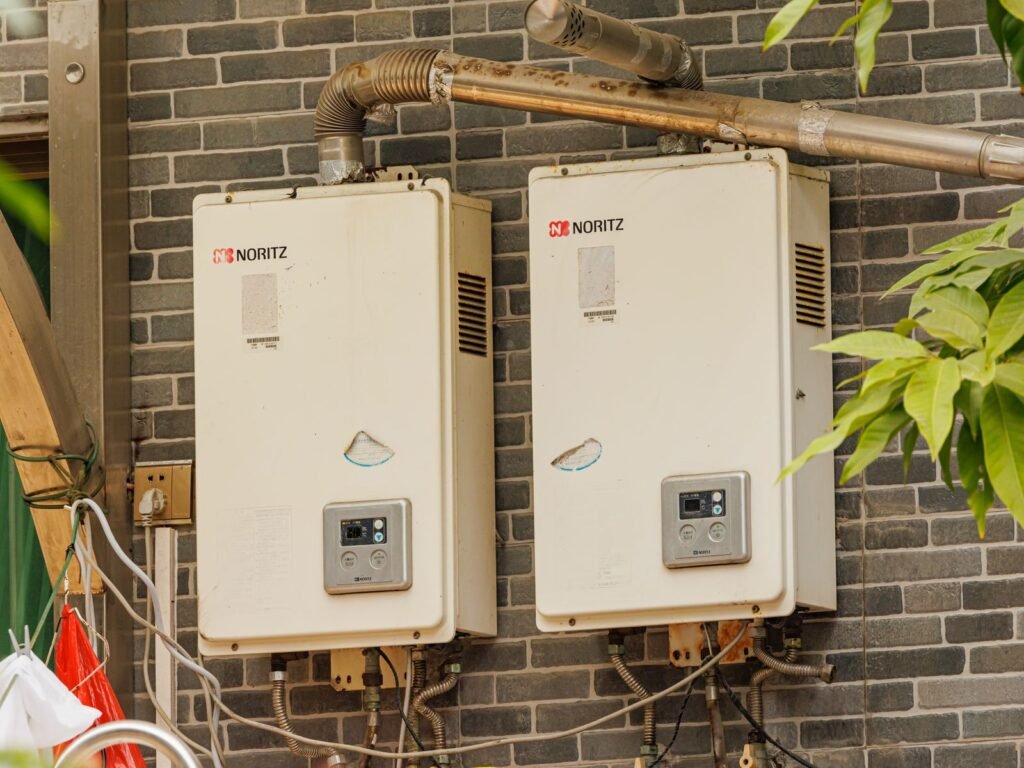
Tankless water heater not heating
A tankless water heater only fires when enough water flows through it, so start with flow, then fuel and power, then the display.
- Flow below the activation rate. Navien lists 0.5 gallons per minute as the minimum for its NPE models, and Takagi’s maintenance sheets give the same figure. A tap opened only a little or a clogged aerator can fall short; Rinnai recommends at least 1 gallon per minute at every fixture.
- A clogged inlet filter. Rinnai, Navien and Takagi all point to a dirty cold water inlet filter when flow is low or the water runs cold.
- Gas or power. Run the same gas checks as for a tank, then check the plug and breaker, because tankless units need electricity to fire.
- An error code. Our guide to what Rinnai code 11 and other tankless error codes mean covers ignition, venting, overheat and scale codes.
- Freeze damage. Navien’s freeze protection only works while the heater has electricity, and its warranty doesn’t cover freezing damage. If a unit in a garage or on an outside wall lost power in a cold snap, shut off its water if a leak appears as it thaws.
- Scale. Mineral scale in the heat exchanger can restrict flow and trigger overheat shutdowns and Rinnai’s LC codes.
Lukewarm water or hot water that runs out fast
Some hot water but not enough usually means the heater is falling behind or cold water is mixing into the hot. Most of these causes come from Bradford White’s electric service manual but apply to gas tanks too:
- Thermostat set low. The Department of Energy suggests 120°F for most homes, and Rheem and Bradford White both list a low setting as a cause of not enough hot water.
- A shower valve or mixing valve. If one shower runs lukewarm while the kitchen tap is hot, suspect that shower’s valve. Code limits shower and tub valves to 120°F, and a limit stop set too low or a worn cartridge can keep one fixture cool. Rinnai also flags faulty fixture valves and mixing valves that let cold water bleed into the hot lines.
- Broken dip tube. The dip tube carries incoming cold water to the bottom of the tank. Bradford White lists a damaged dip tube as a cause; when it breaks, cold water mixes in near the top, where hot water leaves.
- Sediment. Sediment on electric elements slows recovery, and Rheem traces a rumbling gas tank to scale and sediment.
- An undersized heater or a busy hour. Rheem notes that usage can simply exceed the heater’s capacity, so wait for it to recover. If it happens every day, the heater may be too small for the household.
- Colder incoming water in winter. Bradford White lists very cold inlet water as a cause. Water from the street is typically colder in winter, so a tank takes longer to recover and a tankless unit has to raise the temperature further, which can cut its flow at the set temperature; Department of Energy guidance puts a typical gas tankless unit at about a 70°F rise at 5 gallons per minute.
Safe checks, in order
- Gas smell or CO alarm: leave the house and call the gas utility or 911 from outside.
- Water on the floor: close the shutoff valve on the cold water supply pipe at the heater, turn off the gas or the breaker, and see emergency water heater repair. Leaking tanks are scheduled first.
- Test more than one hot tap to tell a whole-house problem from one fixture.
- Check the fuel: gas valve open, other gas appliances working, propane in the tank.
- Check the power: the breaker for an electric tank; the outlet, GFCI and breaker for power vent and tankless units.
- Check the setting on the gas control or tankless controller.
- Read the display or status light and note any code or flash pattern.
- Relight or reset once, following the label or manual. If it fails again, stop.
When to call a plumber
Call when a relight or reset doesn’t hold, when the fix involves gas, venting or wiring, or whenever water is leaking, including:
- A pilot that won’t light or won’t stay lit after one try.
- A tripped FVIR or combustion shutoff.
- A breaker or high-limit that trips again.
- A tankless code that returns after a reset.
- Soot, scorch marks or a yellow flame, which Rheem links to restricted air openings or too little combustion air.
- Any leak from the tank itself.
Our water heater repair in Fort Collins team works on gas, electric and tankless heaters. Every job is done by licensed plumbers covered by liability insurance, with a written, itemized quote before work starts and honest repair-or-replace advice. For a sense of scale, Angi’s December 2025 repair guide puts a thermocouple at about $150 or less, an electric heating element at $200-$300 and a gas control valve at about $350 on average; those are national figures, not our prices.
If the tank is leaking or near the end of its life (the Department of Energy says most storage water heaters last 10 to 15 years), see our page on water heater replacement in Fort Collins; we handle the permit and inspection on every replacement.
No hot water FAQ
Why is there suddenly no hot water in my house?
On a gas tank, the pilot has usually gone out or the gas is off; on an electric tank, a breaker, the high-limit or the upper element has usually failed. On a tankless unit, check the display for a code and open the tap wide.
Why does my hot water run out so fast?
Common causes are a failed lower element on an electric tank, a broken dip tube, sediment, a low thermostat setting, a heater too small for the household or colder incoming water in winter.
Why is my tankless water heater not heating?
Most often the flow is below the activation rate, the inlet filter is clogged, the gas or power is off, or the unit is showing an error code.
Why does my water heater breaker keep tripping?
A shorted heating element is a common cause; Bradford White notes that a grounded element can trip the breaker. Don’t keep resetting it, because the breaker is doing its job.
What temperature should I set my water heater to?
The Department of Energy suggests 120°F for most homes. Code also limits shower and tub valves to 120°F.
Is no hot water an emergency?
Usually not, unless water is leaking, you smell gas or a CO alarm is sounding. For a leak, shut off the cold supply and the gas or breaker and call; leaking tanks are scheduled first.
Keep reading
Related guides
Hot Water Smells Like Rotten Eggs? Causes and Fixes in Fort Collins
Hot water smells like rotten eggs? Why it happens, how an anode rod swap or chlorination fixes it, and when it is a gas leak.
Read guide
Water Heater Leaking in Fort Collins? How to Find the Source and What to Do
Water heater leaking from the top, bottom or relief valve? Find the source, what to do now and when it means a new tank.
Read guide
Water Heater Making Noise? What Each Sound Means and How to Fix It in Fort Collins
Water heater making noise? What popping, rumbling, hissing and banging mean, when a flush fixes it and when to call.
Read guidePhoto credits (Wikimedia Commons): Water Heater Leaking in Fort Collins? How to Find the Source and What to Do: Wikimedia Commons, CC BY-SA 3.0.
Water heater trouble?
Call for water heater repair in Fort Collins, Loveland and Larimer County.
Honest repair-or-replace advice, written and itemized quotes, and tank, tankless or heat pump options.

Water heater replacement, repair and tankless installation for Fort Collins, Loveland and Larimer County. Written, itemized quotes and licensed plumbers.
Call (970) 305-5633