
Water Heater Maintenance in Fort Collins and Loveland
Flushing, anode rod checks and relief valve tests that help a tank last longer.
- Honest repair-or-replace advice
- Written, itemized quotes
- Licensed and insured
Water heater maintenance means draining sediment, checking the anode rod, testing the temperature and pressure (T&P) relief valve, and making sure the burner and venting, or the heating elements, work as they should. Fort Collins Water Heater Pros maintains tank, tankless and heat pump water heaters in Fort Collins, Loveland and across Larimer County, and our licensed plumbers tell you plainly what each check found.
Call (970) 305-5633 to book a water heater flush or a full maintenance visit.
Call nowChoose your area
Permits, water and energy providers differ by town. Pick yours:
Signs your water heater needs maintenance
Causes come from A.O. Smith, Rheem and Rinnai guidance and Fort Collins Utilities.
| What you notice | Likely cause | What we do |
|---|---|---|
| Popping or rumbling from a gas tank | Sediment and scale on the tank bottom | Drain and flush; delime hardened scale |
| Electric heater hissing louder than before | Scale on the heating elements | Flush; clean or replace the element |
| Rotten-egg smell from hot taps only | Bacteria reacting with hydrogen from the anode rod | Disinfect the tank; fit a less active anode |
| Rusty or black hot water | A dissolved anode rod or heavy sediment | Replace the anode; flush the tank |
| Hard white bits clogging faucet aerators | Mineral buildup or a failed plastic dip tube | Flush; replace the dip tube |
| Relief valve drips after the heater runs | Thermal expansion or high water pressure | Check pressure and the expansion tank; replace a worn valve |
| Large or yellow burner flame, or soot | Dirty burner, blocked air supply or a vent problem | Shut it off; clean the burner; fix the air supply and vent |
| Tankless unit shows a service or scale code | Scale in the heat exchanger or a clogged inlet filter | Descale; clean the inlet filter |
| Heat pump alarm, or it keeps running on its elements | Dirty air filter or blocked condensate line | Clean the filter; clear the condensate drain |
If you smell gas, leave the house and call your gas utility from outside. Water seeping from the tank itself means the steel has rusted through, which maintenance cannot fix; see water heater repair in Fort Collins. For odors, read why hot water smells like rotten eggs.
What does water heater maintenance include?
For a tank heater, maintenance means draining sediment, inspecting the anode rod, testing the T&P valve, checking the temperature and any expansion tank, and checking the burner and venting on gas models or the elements on electric ones. Manufacturers set the intervals:
- Flush or partial drain. The U.S. Department of Energy suggests draining a quart every three months to remove sediment. A.O. Smith recommends a full drain and flush after the first six months, then yearly, or more often if a lot comes out. See how to flush a water heater.
- Anode rod inspection and replacement. This sacrificial rod corrodes so the steel tank does not. DOE suggests inspecting it every three to four years, A.O. Smith and Rheem yearly, and Rheem says to replace it once more than 6 inches of core wire shows. Running without one shortens tank life and voids the warranty.
- T&P relief valve test. A.O. Smith says to lift the lever at least yearly, because mineral deposits can make the valve stick; Consumer Reports suggests every six months. The water is scalding, and a valve that will not reseat needs replacing, never capping.
- Temperature at 120°F. DOE recommends 120°F as safe for most households; hotter settings raise the scald risk.
- Expansion tank, where one exists. Expansion tank maker Amtrol says a licensed professional should check it yearly. Colorado’s code requires the tank to be supported, not hung from its pipes. See whether you need a water heater expansion tank.
- Gas models: burner and venting. A.O. Smith calls for a yearly look at the venting, air supply, gas piping and burners; its manual describes a healthy flame as small and blue with a little yellow or orange at the edges, and large flames mean shut it off and call. A blocked vent can spill carbon monoxide, so vent work belongs to a licensed plumber.
- Electric models: elements and thermostats. Bradford White has a technician check the thermostats yearly and the element seals for leaks, and Rheem says louder hissing can mean an element needs cleaning. That work means opening panels on what is usually a 240-volt circuit.
Tankless water heater maintenance
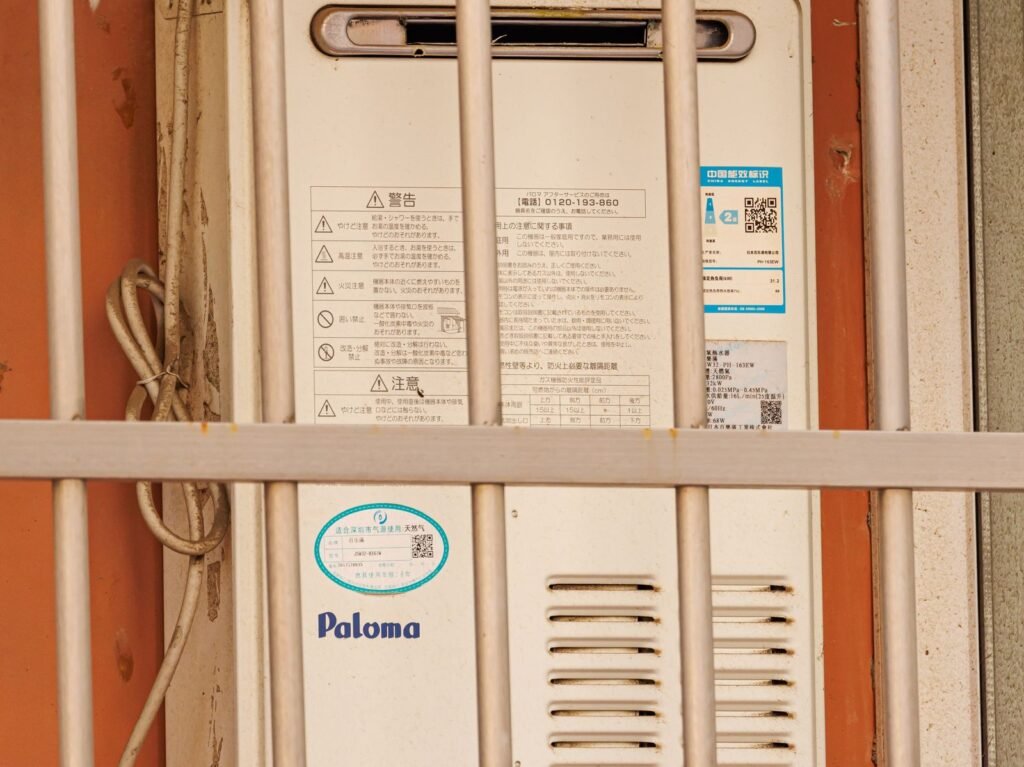
A tankless unit has no tank to drain, and Rinnai’s manual calls for a yearly inspection by a licensed professional.
- Descaling on the manufacturer’s schedule. A DOE Building America guide notes that manufacturers’ intervals run from twice a year to once every three years. Rinnai’s condensing units can show a “Service Soon” code at an interval the installer sets, and Rinnai’s warranty excludes lime damage. See how to descale a tankless water heater.
- Inlet water filter. Close the isolation valves, unscrew the screen at the cold inlet and rinse it (Rinnai).
- Venting and condensate line. Inspect the vent yearly and keep the terminal and condensate line clear of snow and ice (Rinnai).
Our tankless water heater repair service covers descaling, error codes and parts.
Heat pump water heater maintenance
A heat pump water heater still has a tank, so the tank tasks apply, plus two more:
- Air filter. Rheem’s maintenance guide says to check it monthly and clean it with mild soap and water every quarter, or sooner if it looks dirty.
- Condensate drain. Rheem says to check it quarterly. On its units a clogged line sets off an A108 alarm, and the heater falls back on its electric elements.
Rheem also suggests 18 to 24 inches of clearance. More on our heat pump water heater page.
What a maintenance visit from us covers
Tell us what you have noticed; depending on the heater, our plumbers check:
- The rating plate: age, size, fuel and model
- The T&P valve and its discharge pipe
- Sediment, with a drain and flush
- The anode rod, where it is accessible
- Water temperature at a tap, and static water pressure
- The expansion tank’s pre-charge and support, if you have one
- Gas: burner flame, venting, draft, combustion air and gas connections
- Electric: elements, thermostats and wiring
- Tankless: scale, the inlet filter, venting and the condensate line
- Heat pump: the air filter, condensate drain and clearance
If anything needs repair, your written, itemized quote names the part and the labor before work starts, with honest advice when a new heater makes more sense; see water heater replacement in Fort Collins. Every job is done by licensed plumbers and covered by liability insurance.

What water heater maintenance costs
National cost guides give a starting point, not a Fort Collins quote:
| Job | National figure | Source |
|---|---|---|
| Tank flush | $75-$150, average $115 | Angi flush cost guide, updated Dec 23, 2025 |
| Tankless flush | $150-$250, average $200 | Angi flush cost guide, updated Dec 23, 2025 |
| Annual tankless descaling | Around $100-$500 | This Old House tankless cost guide, updated June 12, 2026 |
| Anode rod replacement | $50-$150 including labor | HomeAdvisor repair cost guide, updated June 17, 2026 |
| T&P relief valve | $20-$200 | HomeAdvisor repair cost guide, updated June 17, 2026 |
| Replacing an expansion tank | $100-$400 | Angi repair cost guide, updated Dec 17, 2025 |
If a check turns up a failing tank, our water heater replacement cost guide covers what a new one runs.
Is Fort Collins water hard? What soft water means for maintenance
No. Every local water provider that publishes a hardness figure reports soft water, roughly 14 to 35 mg/L, or about 0.8 to 2 grains per gallon. Scale builds more slowly than in hard-water cities, but tanks still collect sediment and anodes still wear out.
The City of Loveland Utilities’ 2025 report gives a yearly average of 24 mg/L, about 1.4 grains per gallon. Longmont averages about 22 mg/L, Estes Park 14, and Soldier Canyon treated water (for ELCO, the Fort Collins-Loveland Water District and North Weld) 21 to 32. Fort Collins Utilities publishes no figure but calls its water naturally soft. Loveland and Longmont say their customers do not need a softener, and claims online that Loveland water runs 10 to 17 grains per gallon do not match Loveland’s own report.
Maintenance still matters because:
- Some minerals settle anyway. State Water Heaters notes that lime is in every water system to some degree and comes out faster as water heats.
- Soft water is harder on steel. Rheem says hard water leaves a protective film that soft water does not, and Fort Collins Utilities has added calcium and carbon dioxide since 1984 because untreated soft water can be corrosive.
- Softeners wear anodes faster, according to A.O. Smith and Rheem.
- Private wells differ, and they are common around LaPorte, Bellvue and Masonville.
Water heater maintenance FAQ
How often should a water heater be serviced?
Once a year is the usual manufacturer schedule: Bradford White and Rinnai call for an annual inspection by a qualified professional, and A.O. Smith for a yearly drain, anode check and relief valve test.
How often should a water heater anode rod be replaced?
When it is used up. DOE suggests inspecting it every three to four years and A.O. Smith yearly, and Rheem says to replace it once more than 6 inches of core wire shows; a water softener makes it wear faster.
Do I still need to flush my water heater if my water is soft?
Yes. Soft water builds scale slowly, but sediment still settles; A.O. Smith suggests a first flush at six months and a schedule set by how much comes out.
How do I test a water heater relief valve?
Check that the discharge pipe ends somewhere safe, stand clear and lift the lever briefly; hot water should flow freely and stop when you let go. If it keeps running or dripping, close the cold-water supply and call, because the valve needs replacing.
How much does a water heater flush cost?
Angi’s December 2025 flush cost guide puts a tank flush at $75 to $150 nationally, averaging $115, and a tankless flush at $150 to $250. Your written, itemized quote gives the actual price.
Can I maintain my water heater myself?
Partly. Draining a quart, testing the relief valve and checking the temperature are reasonable with care around scalding water; anode swaps take a 1-1/16-inch socket and often a breaker bar, and burners, venting, gas controls and wiring need a licensed plumber.
What happens if you never flush a water heater?
Sediment hardens on the bottom of the tank. Rheem says it lowers efficiency, can cause rumbling and eventually clogs the drain valve, and A.O. Smith says draining sediment extends a heater’s life.
Related services
Water Heater Repair
No hot water, leaks, pilot and burner problems diagnosed and fixed.
Learn more
Tankless Repair and Descaling
Error codes, lukewarm water and scale buildup fixed.
Learn more
Water Heater Installation
Gas and electric installs with the expansion tank, venting and permit done right.
Learn morePhoto credits (Wikimedia Commons): Tankless Repair and Descaling: Dinkun Chen, CC BY-SA 4.0; Water Heater Installation: Tim Evanson, CC BY-SA 2.0.
Water heater trouble?
Call for a diagnosis and a written quote.
Call for water heater maintenance in Fort Collins, Loveland or anywhere in Larimer County.

Water heater replacement, repair and tankless installation for Fort Collins, Loveland and Larimer County. Written, itemized quotes and licensed plumbers.
Call (970) 305-5633