
How to Flush a Water Heater Safely: Gas and Electric Steps for Fort Collins Homes
How to flush or drain a gas or electric water heater safely, how often to do it on Fort Collins' soft water, and when to call.
To flush a water heater, turn off the gas or power, let the tank cool, close the cold-water supply and drain the tank through a garden hose, then run fresh water through it until it comes out clear and refill it completely before turning the heat back on. Manufacturers’ schedules range from a few quarts a month to a full flush once a year, and Fort Collins Water Heater Pros flushes tanks in Fort Collins, Loveland and across Larimer County if you would rather not do it yourself.
Call (970) 305-5633 to have a licensed plumber flush your water heater and check the anode rod and relief valve while it is drained.
Call nowBefore you start
Flushing is a fair job for a careful homeowner, with three warnings:
- Tank water scalds. A.O. Smith warns that even 120°F water can scald, and the tank may be set hotter. Cool the water first and keep everyone away from the hose end, as Rheem’s flushing bulletin says.
- If you smell gas, stop. Leave the house and call your gas utility from outside. Do not touch light switches or try to relight anything.
- If the tank itself leaks, a flush will not fix it. A leak from the steel cannot be repaired, so shut off the water and the gas or power and call.
You need a garden hose that reaches a floor drain or the outdoors, a bucket, a flat screwdriver for slotted drain valves, and a hose cap in case the valve drips afterward.
How to flush a water heater, step by step
These steps follow A.O. Smith’s and Bradford White’s manuals and Rheem’s flushing bulletin; check your own manual too, since controls differ.
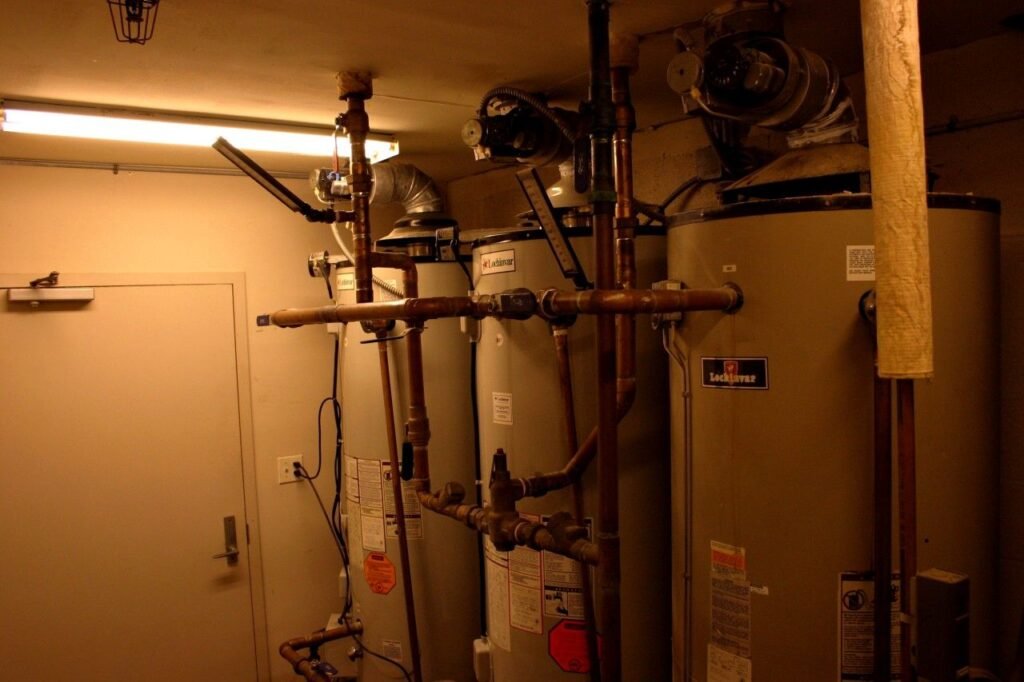
- Turn off the heat. On a gas heater, turn the gas control to OFF (newer electronic controls have a power switch) and close the manual gas valve on the supply pipe. On an electric heater, switch off its breaker.
- Cool the water. Open a hot faucet near the heater and let it run until the water turns cool, then leave it open. A.O. Smith says this can take 10 minutes or longer.
- Connect a hose to the drain valve near the bottom of the tank and run the other end to a floor drain, outdoors or a bucket. The water drains by gravity, so keep the hose running downhill.
- Close the cold-water supply valve on the pipe feeding the heater. Code requires one at or near every water heater.
- Open the drain valve and let the tank empty; the open faucet lets air in. Rheem’s bulletin vents through the relief valve instead, but A.O. Smith warns that mineral deposits can make relief valves stick, so a faucet is gentler.
- Flush with fresh water. With the drain still open, open the cold supply and let water run through the tank until it comes out clear, as A.O. Smith directs. Keep the hose end secured, because it is now under house pressure.
- Close the drain valve and disconnect the hose. Watch the valve’s spout for drips.
- Refill completely. Leave the cold supply open and the hot faucet running until the stream is steady, with no sputtering. A.O. Smith says to let the faucet run full for at least three minutes so all the air is out.
- Restore the heat only when the tank is full. Bradford White warns that electric elements fail if switched on before they are fully under water, and its warranty excludes that dry-firing damage. On a gas heater, open the gas valve and relight by the label’s instructions; A.O. Smith says a tank of cold water can take an hour or more to heat.
- Check the drain valve again once the tank is hot, as Rheem’s bulletin suggests.
How to drain a water heater completely
Sometimes the goal is an empty tank: before a replacement, or when a heater will sit unused where it could freeze, such as a foothill cabin over winter. Follow steps 1 to 5 and stop there.
A.O. Smith’s Signature manual says to drain a heater shut down during freezing temperatures and leave the drain valve open while it sits. Rheem’s manual says to turn off the power and water to a heater left idle for a long time and to have a qualified technician check its controls afterward. Either way, never turn the heat back on until the tank is completely full.
Plastic or brass drain valve: check before you turn it
Drain valves come in plastic and brass, so check which you have.
- Plastic valves often turn with a knob or a flat screwdriver in a slot. Turn them gently, never with pliers, and do not crank them closed, because old plastic can crack.
- Brass valves are sturdier. Bradford White’s specifications call for a “low restrictive” brass drain valve on its residential atmospheric gas heaters, and a Rheem Professional Classic spec sheet lists an “enhanced flow” brass valve, both designed to drain more freely.
- Size and swaps. Code calls for a drain valve of at least 3/4 inch with male hose threads, and Rheem’s replacement bulletin uses a standard 3/4-inch pipe-thread valve, so a worn plastic valve can usually be swapped for brass once the tank is drained.

What to do if the drain valve clogs or will not reseal
A trickle or no flow usually means sediment is blocking the valve, and a drip after closing usually means grit on the seat or a worn valve. Neither needs force.
If it clogs. Rheem’s bulletin warns that enough sediment will eventually clog a drain valve, and A.O. Smith says to call a qualified person if the tank will not drain. With the hose secured and the valve open, opening the cold supply for a moment sometimes pushes a loose clog through, since A.O. Smith’s own flush relies on house pressure. If not, close the valve, refill the tank fully, restore the heat and call. Do not poke wire into the valve or hammer on it.
If it will not reseal. Close it snugly by hand; opening it fully for a few seconds can rinse grit off the seat before you close it again. A hose cap on the threads is a common stopgap for a slow drip from the spout. If it keeps dripping, or water seeps where the valve threads into the tank, it needs replacing, which means draining the tank, as Rheem’s replacement bulletin shows.

How often should you flush a water heater?
Follow your heater’s manual: schedules range from a few quarts a month to a full flush once a year, and the U.S. Department of Energy suggests a quart every three months. On soft local water, A.O. Smith’s method is a sensible start: flush at six months, see how much sediment comes out, then set the interval.
| Source | What it recommends |
|---|---|
| U.S. Department of Energy, Energy Saver Guide | Drain a quart every 3 months |
| A.O. Smith gas manual (2023) | Drain and flush after the first 6 months; then yearly if there is little sediment, more often if there is a lot |
| A.O. Smith Signature 100 manual (2021) | Drain and flush every 6 months |
| Rheem flushing bulletin | Flush at least every 6 months; monthly in some areas |
| Rheem gas power-vent manual | Drain a few quarts every month |
| Bradford White electric manual | Drain a gallon every month |
Rheem’s bulletin adds that no single schedule fits every heater, because water conditions, the thermostat setting and how much hot water you use all change how fast sediment builds.
For DOE’s quart routine, set a bucket under the drain valve, open it until about a quart comes out, then close it fully. That water is as hot as the tank, so keep your hands clear of the spout, as A.O. Smith warns.
Do you still need to flush on Fort Collins’ soft water?
Yes, though sediment builds more slowly than in hard-water towns. The City of Loveland Utilities’ 2025 report averages 24 mg/L of hardness, about 1.4 grains per gallon, Longmont averages about 22 mg/L, and Fort Collins Utilities calls its water naturally soft. Still, State Water Heaters’ service handbook notes that lime is present in every water system to some degree and comes out faster as water heats, and private wells can differ. Our water heater maintenance page covers what soft water means for anode rods and tankless units.
What comes out of the tank, and what it means
- White or tan flakes and grit: normal scale and sediment, as Rheem’s bulletin notes.
- Hard white bits that also clog faucet aerators: Fort Collins Utilities names two usual causes, mineral buildup and a failed plastic dip tube.
- Rusty or black water: Rheem’s troubleshooting guide points to a dissolved anode rod or heavy sediment.
- A rotten-egg smell: usually bacteria reacting with the anode; see why hot water smells like rotten eggs.
- Still rumbling after a good flush: hardened scale may need a deliming product used exactly as labeled, as State’s handbook advises, or the tank may be wearing out; see water heater making noise.
Tankless units collect scale in the heat exchanger instead and are descaled, not drained; see tankless water heater repair.
When to stop and call a plumber
- The drain valve is clogged, cracked or will not stop dripping
- Water seeps from the tank body or from under the jacket
- You smell gas, or the pilot will not relight
- An electric heater makes no hot water after refilling, which can mean an element burned out
- The tank still rumbles after several flushes
- You would rather not handle gas controls or a 240-volt circuit
Our plumbers flush tanks, replace drain valves and anodes, and give honest repair-or-replace advice when an older heater is near the end. If it is time for a new one, start with water heater replacement in Fort Collins.
Water heater flushing FAQ
How often does a water heater need to be flushed?
Follow your manual. A.O. Smith says after the first six months, then yearly or more often if sediment is heavy; Rheem’s bulletin says at least every six months.
Can you flush a water heater without draining it completely?
Yes. A.O. Smith’s Signature manual describes flushing with the cold supply left on, so water runs in and out through the open drain valve until it comes out clean; cool the water and turn off the heat first.
Do I have to turn off the water heater before flushing it?
Yes. Turn the gas control to OFF or switch off the breaker, and keep it off until the tank is full again, because electric elements fail if they run dry.
What if my water heater drain valve will not close?
Close it snugly by hand and cap the hose threads as a stopgap. If it keeps dripping or leaks where it meets the tank, it needs replacing.
Is it safe to flush an old water heater?
Usually, but a neglected tank can clog its drain valve, and an old plastic valve may not reseal. If the heater is past 10 years old or rumbles loudly, consider having a plumber flush it and check the anode.
Keep reading
Related guides

Do I Need a Water Heater Expansion Tank? The Rules in Fort Collins and Larimer County
When code requires a water heater expansion tank, how to tell if your home is a closed system, and signs a tank has failed.
Read guide
Are Heat Pump Water Heaters Worth It? Pros, Cons and Payback in Fort Collins
Are heat pump water heaters worth it? Honest pros and cons, a payback example with 2026 rebates and Colorado winter tips.
Read guide
Colorado's Low-NOx Water Heater Law: What Changes When You Replace a Gas Water Heater in 2026
What Colorado’s low NOx water heater law means for a 2026 gas replacement: limits, propane, altitude and exemptions. Call (970) 305-5633 for a quote.
Read guidePhoto credits (Wikimedia Commons): Colorado's Low-NOx Water Heater Law: What Changes When You Replace a Gas Water Heater in 2026: Jason Woodhead, CC BY 2.0.
Water heater trouble?
Call for a diagnosis and a written quote.
Call to book a water heater flush with a licensed plumber in Fort Collins, Loveland or nearby towns.

Water heater replacement, repair and tankless installation for Fort Collins, Loveland and Larimer County. Written, itemized quotes and licensed plumbers.
Call (970) 305-5633