
Water Heater FAQ: Fort Collins and Loveland
Straight answers on replacement, repair, tankless, heat pumps, permits and costs.
- Honest repair-or-replace advice
- Written, itemized quotes
- Licensed and insured
Replacing a standard tank water heater typically takes 1 to 3 hours, according to HomeAdvisor’s cost guide (updated June 2026); fuel changes, new venting and tankless conversions take longer, and the inspection is often a separate visit. Fort Collins Water Heater Pros repairs and replaces water heaters in Fort Collins, Loveland and across Larimer County.
Call (970) 305-5633 if your water heater is leaking now or you want a written, itemized replacement quote.
Call nowWater heater replacement: time and cost
How long does it take to replace a water heater?
A like-for-like tank swap typically takes 1 to 3 hours (HomeAdvisor, June 2026), and This Old House’s June 2026 tankless guide estimates 4 to 8 hours of labor for a tankless unit. Moving the heater, changing fuel or adding venting takes longer. Our water heater installation page walks through the day.
How much is a new water heater?
Angi’s July 2026 cost guide puts a tank water heater replacement at $882 to $1,825 nationally, averaging $1,346. This Old House’s June 2026 guides put tankless installation at $1,200 to $3,500 and heat pump water heaters at $2,500 to $3,500. These are national figures, not our prices; our water heater replacement cost guide explains local price drivers.
Repair or replace
How long should a water heater last?
Most storage water heaters last 10 to 15 years and tankless units more than 20, according to the U.S. Department of Energy, and ENERGY STAR’s savings estimates assume 13 years for a heat pump model. Angi’s July 2026 guide says gas tanks often last 8 to 12 years. Our guide to how long water heaters last shows how to read your heater’s age.
Should I repair or replace my water heater?
Repair a sound tank with a failed part, such as a thermocouple, element, thermostat, T&P valve or anode rod; replace a tank leaking from its body, since rusted-through steel typically cannot be repaired, or an older heater facing a big repair. For scale, Angi puts a thermocouple at about $150 or less (December 2025) and an average tank replacement at $1,346 (July 2026). We give honest advice on every water heater repair visit, including when water heater replacement in Fort Collins makes more sense.
Tankless and heat pump water heaters
Is a tankless water heater worth it in Fort Collins?
It can be. The U.S. Department of Energy says tankless units can be 24% to 34% more efficient than storage tanks in homes using 41 gallons of hot water a day or less. The trade-offs are a higher installed price, often with a larger gas line and new venting (This Old House’s June 2026 tankless guide puts each at $400 to $800), and, for gas models, some capacity lost to altitude. Our tankless water heater pros and cons guide compares the options.
Can a tankless water heater run out of hot water?
Not like a tank, but it heats only so many gallons per minute: the U.S. Department of Energy says a 70°F rise is typically possible at 5 gallons per minute through gas-fired units and 2 through electric ones. Too many fixtures at once means cooler water, so we size by flow; see our water heater sizing guide.
Do heat pump water heaters work in Colorado winters?
Yes, if the room suits them. ENERGY STAR says a heat pump water heater takes heat from the surrounding air and belongs in an interior space that stays between 40°F and 90°F year-round, with 1,000 cubic feet of air around it, so a roomy basement often works. ENERGY STAR estimates savings of about $550 a year for a household of four over a standard electric tank; see our heat pump water heater page.
What water heater rebates and tax credits are available in 2026?
Mostly for heat pump models. Efficiency Works pays Fort Collins, Loveland, Longmont and Estes Park electric customers up to $600 when replacing an electric or propane heater and $400 when replacing gas; Xcel Energy lists a $750 standard rebate, and Poudre Valley REA pays members $350. Colorado’s $250 heat pump credit takes at least $83 off your invoice through a registered installer, while the federal 25C credit ended December 31, 2025. Check current amounts with your utility, and see our heat pump water heater rebates guide.
Permits and Colorado rules
Do you need a permit to replace a water heater?
Yes. Every city, town and county we serve requires a permit and inspection, even for a like-for-like swap, and the Colorado State Plumbing Board’s December 2025 memo requires a licensed plumber working for a state-registered plumbing business, under a permit. We pull the permit and schedule the inspection on every replacement; our water heater permit guide covers all 16 towns.
Can I replace my own water heater in Colorado?
Only in your own home, doing the work yourself, when the home is not for sale, resale, a flip or a rental, under a December 4, 2025 addendum to the State Plumbing Board’s memo. You still need a permit and inspection, and Fort Collins, Loveland, Milliken and unincorporated Weld County also require a homeowner affidavit. The state’s homeowner notice adds that a handyman who is not a registered plumbing business may not do the work.
How much does a water heater permit cost?
It depends on who issues it. Fort Collins charges $65 per water heater plus sales tax on the job’s value, Longmont $40 plus sales tax on half the job’s value, Berthoud $150 plus $25 administration and $25 technology fees, unincorporated Larimer County $66.42 for jobs valued up to $2,000, and unincorporated Weld County $115.41 for jobs up to $20,001. Loveland, Greeley, Timnath, Wellington and Estes Park base the fee on the job’s value.
Do I need an expansion tank with a new water heater?
Only if your plumbing is a closed system. The 2024 International Residential Code requires thermal expansion control where a pressure-reducing valve, check valve or backflow preventer lets heated water build pressure, and Colorado’s plumbing code says the tank must be supported as its manufacturer specifies, not by its piping. Our water heater expansion tank guide explains how to tell.
Is Colorado banning gas water heaters?
No. Since January 1, 2026, HB23-1161, as amended by SB26-002, has restricted the sale, distribution and lease of new gas water heaters above 10 nanograms of NOx per joule (up to 75,000 Btu/h, or with power assist) or 14 ng/J (larger units). ENERGY STAR certified models are deemed to comply, and stock in Colorado before 2026 can still be sold. It does not require replacing a working heater or ban installing or repairing existing units; see our Colorado low NOx water heater law guide.
Does the NOx rule cover propane, electric and heat pump water heaters?
Propane models are exempt from August 12, 2026 until January 1, 2031 under SB26-002. Electric and heat pump water heaters burn no fossil fuel, so the rule does not apply, though new electric storage water heaters of 40 to 120 gallons sold in Colorado since January 1, 2026 must have an AHRI 1430 demand response port.
Water quality and maintenance
Is the water hard in Fort Collins and Loveland?
No. Loveland’s 2025 Drinking Water Quality Report gives a yearly average of 24 mg/L, about 1.4 grains per gallon, so claims that Loveland water runs 10 to 17 grains do not match the city’s own figure. Fort Collins Utilities says its source water is naturally soft, and Longmont (about 22 mg/L) and Estes Park (14) measure soft too. Sediment and anode wear still happen, so water heater maintenance still matters.
Do I need a water softener for my water heater?
Usually not on public water here. Loveland’s water quality FAQ says customers don’t need one, Longmont’s report advises against one, and A.O. Smith says a softener makes a tank’s anode rod wear faster. Local 2025 figures of 14 to 35 mg/L sit far below the 200 mg/L limit in Rinnai’s tankless manual, though a private well can test differently.
How often should I flush my water heater?
The U.S. Department of Energy suggests draining a quart from the tank every 3 months and checking the anode rod every three to four years, unless your manual says otherwise. Tankless units need flushing or descaling on their manual’s schedule, even on soft water. Turn off the gas or power first, and take care, because tank water can scald; see how to flush a water heater and how to descale a tankless water heater.
Altitude and gas water heaters
Does altitude affect a gas water heater in Fort Collins?
Yes. The fuel gas code (IFGC 402.2) requires the volume of gas supplied to be adjusted above 2,000 feet, USGS puts Fort Collins at 5,004 feet and Loveland at 4,986, and each heater is set up by its manufacturer’s instructions. Rinnai, for example, derates one 199,000 Btu/h model about 15%, to 170,000 Btu/h, in its 2,001 to 5,200 foot band; our tankless water heater installation page has the full table.
Do homes in Estes Park and Livermore need a different altitude setup?
Often, yes. At their USGS points, Estes Park (7,530 feet), Livermore (5,890), Masonville (5,391) and Wellington (5,207) sit in Rinnai’s 5,201 to 7,700 foot band, where one 199,000 Btu/h model drops to 153,000 Btu/h, and Navien’s NPE-2 natural gas units need a high-altitude kit at 5,400 feet or higher. Settings follow each home’s own elevation, so we check foothill lots on site, as our Estes Park water heater repair page explains.
Leaks, gas smells and other emergencies
What should I do if my water heater is leaking?
Close the cold water valve above the heater, turn the gas control to OFF or switch off the breaker, and keep clear of the water, which can scald. Then call us; leaking tanks are scheduled first. Our emergency water heater repair steps and water heater leaking guide go further.
What should I do if I smell gas near my water heater?
Leave the house without touching light switches or using a phone inside, and call your gas utility, propane supplier or 911 from outside; Xcel Energy supplies gas to most of the area, Atmos Energy to Greeley and parts of Windsor, and Black Hills Energy to Wellington. Don’t relight the pilot. If a carbon monoxide alarm sounds, get everyone out and call 911.
Can I cap a dripping relief valve?
Never cap or plug a temperature and pressure (T&P) relief valve; it protects the tank when pressure or temperature climbs too high. A drip usually means water pressure above the code’s 80 psi limit, thermal expansion with no working expansion tank, debris or a worn valve, and each has a fix.
Working with Fort Collins Water Heater Pros
Are your plumbers licensed and insured?
Yes. Every job is done by licensed plumbers and covered by liability insurance. Colorado’s Division of Professions and Occupations warns that homeowner’s insurance may not cover damage from work by anyone without liability insurance. Our how it works page explains who comes out and what happens next.
Will I get a written quote before work starts?
Yes, written and itemized, before any work starts. It lists the heater’s make, model, size, first-hour rating and UEF, labor, the permit and inspection, any code items the job needs, venting changes, altitude setup and haul-away of the old tank, so you can compare it line by line with any other quote.
Which towns do you serve?
Fort Collins, Loveland, Windsor, Greeley, Longmont, Timnath, Wellington, Berthoud, Johnstown, Severance, Milliken, Estes Park, LaPorte, Bellvue, Masonville and Livermore. Permits come from your city or town, or from Larimer County in unincorporated LaPorte, Bellvue, Masonville and Livermore; our water heater service areas page has details for each town.
Related services

Water Heater Installation
Gas and electric installs with the expansion tank, venting and permit done right.
Learn more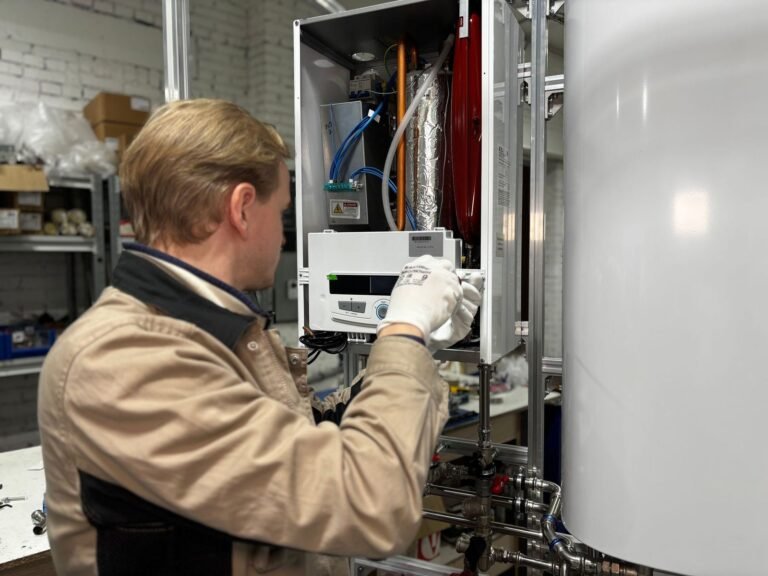
Water Heater Repair
No hot water, leaks, pilot and burner problems diagnosed and fixed.
Learn more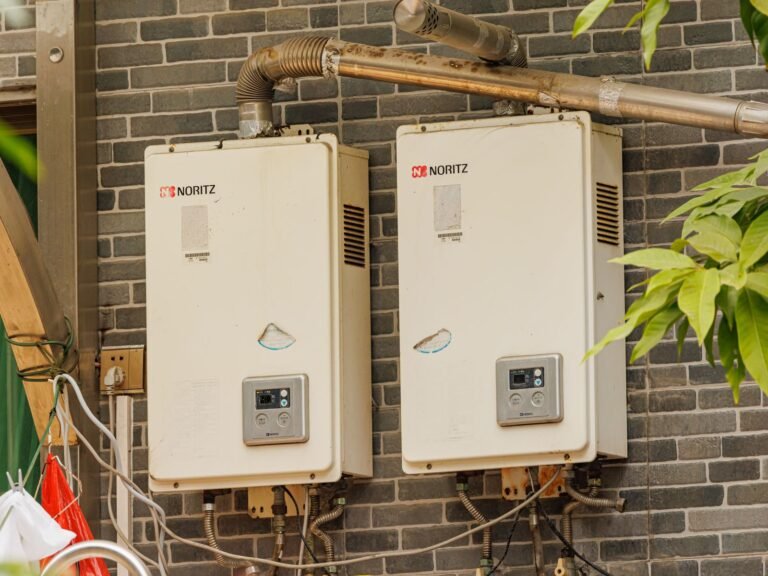
Tankless Water Heater Installation
Sized for your household, with gas line, venting and altitude handled.
Learn morePhoto credits (Wikimedia Commons): Water Heater Installation: Tim Evanson, CC BY-SA 2.0; Tankless Water Heater Installation: Dinkun Chen, CC BY-SA 4.0.
Water heater trouble?
Call for a diagnosis and a written quote.
Call for honest repair-or-replace advice and a written, itemized quote in Fort Collins, Loveland or any town we serve.

Water heater replacement, repair and tankless installation for Fort Collins, Loveland and Larimer County. Written, itemized quotes and licensed plumbers.
Call (970) 305-5633