
Power Vent Water Heater vs Atmospheric, Direct Vent and Condensing: Venting Types and Larimer County Rules
How a power vent water heater compares with atmospheric, direct vent and condensing models, plus Larimer County vent rules. Call before you replace.
A power vent water heater uses an electric blower to push exhaust through plastic pipe, usually out a side wall, so it needs an outlet but no chimney. Atmospheric heaters let hot exhaust rise up a metal vent or chimney, direct vent heaters draw combustion air from outdoors through a sealed vent, and condensing heaters cool their exhaust enough for plastic pipe and need a condensate drain. Fort Collins Water Heater Pros installs every type in Fort Collins, Loveland and Larimer County; the right one depends on your vent path, power and local code.
Call (970) 305-5633 to have our plumbers check your venting before you pick a replacement.
Call nowWater heater venting types compared
The right water heater vent pipe and its maximum length come from the heater’s installation manual, so treat this table as a guide.
| Venting type | How it works | Vent material | Needs power? | Where it ends | Typical use |
|---|---|---|---|---|---|
| Atmospheric (natural draft) | Exhaust rises through a draft hood up a vertical vent | Metal connector into B-vent or a lined chimney | No, on standard models | Above the roof | Standard gas tank on a chimney or B-vent |
| Power vent | A blower pushes exhaust out | PVC, CPVC or ABS where the manual lists it | Yes, a 120-volt outlet | Side wall or roof | No usable chimney, or a heater far from the roof |
| Direct vent | Sealed combustion through a concentric or two-pipe vent | The manufacturer’s vent kit | Often no | Usually a side wall near the heater | Closets and tight rooms |
| Power direct vent | Sealed combustion plus a blower | Plastic pipe listed in the manual | Yes | Side wall or roof, with longer runs | Sealed combustion with a long vent path |
| Condensing (tank or tankless) | Pulls extra heat from the exhaust until moisture condenses | PVC, CPVC or polypropylene per the manual | Yes | Side wall or roof | High-efficiency tanks and many gas tankless units |
How does a power vent water heater work?
A power vent water heater has a blower on top of the tank that pushes exhaust through plastic pipe instead of relying on hot gases to rise. Bradford White’s installation manual for one power vent model lays out the sequence: the thermostat calls for heat, the blower starts, a pressure switch confirms airflow, a spark lights the pilot, the burner fires, and the blower purges the vent briefly after shutdown.
That design brings trade-offs:
- It needs electricity. The same manual calls for a grounded three-prong outlet within 6 feet of the heater, not on a circuit controlled by a light switch. No power means no hot water.
- Only listed plastics. Bradford White lists Schedule 40 PVC, CPVC, ABS and listed polypropylene for US installs and prohibits cellular-core PVC and CPVC.
- Vent length is limited. Every elbow counts against the maximum run; that manual counts a 90-degree elbow as 5 feet of straight pipe.
- Altitude matters. Bradford White says the blower’s capacity drops as altitude rises because the air is thinner, and tells installers above 2,500 feet to get a high-altitude kit from the supplier. Every town we serve sits above 4,600 feet.
- It costs more. Angi’s July 2026 cost guide puts a power vent unit at $300-$600 more than a standard model, plus $300-$500 for electrical work. Those are national figures; our water heater replacement cost guide explains what drives a local quote.
Atmospheric (natural draft) venting
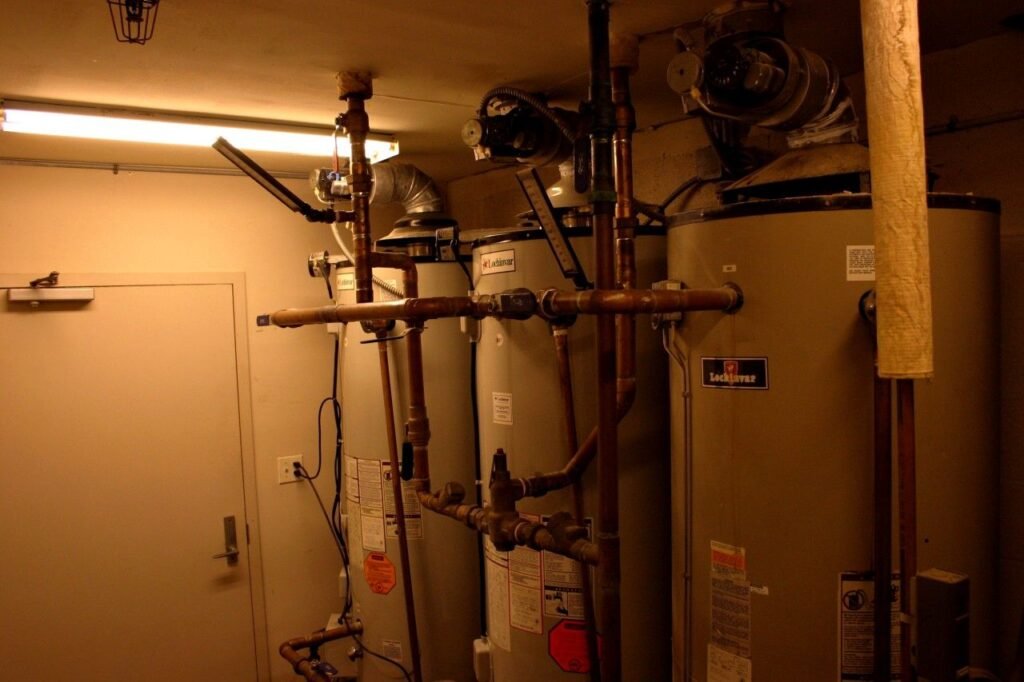
An atmospheric water heater has no fan. Hot exhaust rises through the flue in the middle of the tank, through the draft hood on top and up a metal vent to the outdoors, while room air feeds the burner. It is the simplest gas setup, but it only works when the vent rises properly, is sized for what it serves and stays warm enough to draft.
Because the burner uses indoor air, the room needs enough of it. The residential code’s standard method calls for 50 cubic feet of indoor air per 1,000 Btu/h of total appliance input, and Fort Collins requires combustion air openings to carry a warning that blocking them can release carbon monoxide. A tight closet, a blocked air inlet or a vent that spills exhaust can starve the flame, and a water heater pilot light that keeps going out is sometimes the first sign.
The Department of Energy’s building science guidance recommends sealed-combustion, direct-vent gas heaters because they are nearly impossible to backdraft, and notes that a power-vented heater also avoids backdrafting.
Direct vent and power direct vent water heaters
A direct vent water heater seals the burner off from the house: combustion air comes in from outdoors and exhaust goes out through a concentric pipe or a pair of pipes. Standard direct vent tanks typically vent through a nearby side wall without a blower, while power direct vent models add one for longer runs and need an outlet.
Sealed combustion opens up locations an atmospheric heater can’t use. Fort Collins’ fuel gas code keeps fuel-burning appliances out of bedrooms, bathrooms and storage closets, with exceptions that include direct-vent appliances. For tankless units, Navien recommends running both the intake and the exhaust directly outdoors, because it says freezing damage most often comes from backdrafting caused by negative pressure in the house.
Condensing water heaters: PVC venting and a condensate drain
A condensing water heater pulls so much heat from its exhaust that water vapor condenses inside it. The cooled exhaust can run through plastic pipe, and ENERGY STAR notes that condensing gas storage models need PVC venting and a condensate drain; many gas tankless units are built the same way.
The condensate is acidic, so Noritz says it generally runs through a neutralizer before a floor drain, with local code deciding whether one is required. In a Colorado winter the bigger risk is freezing: Rinnai and Noritz both describe frozen or clogged condensate lines backing up into the heater and shutting it down with an error code, so the drain needs a route that stays above freezing.

What is an orphaned water heater?
An orphaned water heater is a gas water heater left alone on a chimney or vent it used to share with a furnace. It usually happens when an old furnace is replaced with a high-efficiency model that vents through its own plastic pipe, leaving a flue sized for two appliances serving one.
A vent that is too big for what’s left may not draft well, and in a cold masonry chimney the exhaust can cool and condense, which can damage the chimney and let exhaust spill into the house. Bradford White’s power vent manual makes the general point: when an existing natural-draft (Category I) appliance is removed or replaced, the old vent may no longer be sized for the appliances still connected.
The fix is typically a properly sized liner or a venting change, such as a power vent or direct vent water heater; This Old House’s June 2026 cost guide lists a new chimney liner at $500-$700 nationally. If you’re replacing a furnace, have the water heater vent checked at the same time, and keep a working CO alarm near the bedrooms either way.
Water heater venting requirements in Fort Collins, Loveland and Larimer County
These local rules apply on top of the heater’s installation manual:
- Pressure test for new plastic exhaust vents. Colorado’s fuel gas code requires a new plastic exhaust vent on a gas water heater to be tested at 5 psi of air (or a 10-foot water column) at inspection, before it is connected; listed UL 1738 systems installed per the manufacturer are exempt. Larimer County has the same test.
- Loveland. An exhaust test certification goes with the inspection, plastic venting on gas appliances is tested, and cellular-core pipe is not allowed on the exhaust side of direct-vent appliances; existing cellular core must be replaced.
- Windsor. A town policy prohibits cellular-core PVC in water heater and boiler exhaust vents.
- Termination height. Fort Collins and Larimer County require gas vents to end at least 22 inches above the grade below, and Larimer County also requires vent terminals at least 12 inches above the expected snow level.
- CO alarms. Loveland’s permit application quotes state law requiring a working CO alarm within 15 feet of each bedroom entrance when a fuel-fired appliance is replaced under a permit, and Weld County’s express permit requires smoke and CO detectors when fuel-fired appliances are replaced.
Every town in our area requires a permit for a water heater replacement, and we pull the permit and schedule the inspection on every replacement. Colorado’s 2026 NOx rule (HB23-1161) also shapes the choice: most new natural gas water heaters sold here must emit no more than 10 ng/J of NOx if rated up to 75,000 Btu/h or built with power assist, or 14 ng/J above that, and our guide to Colorado’s low NOx water heater law covers the exemptions.
Which venting type fits your home?
The right choice usually comes down to the vent you already have and where the heater sits:
- A sound chimney or B-vent that still fits the heater: an atmospheric replacement is often the simplest swap.
- No usable chimney, or a furnace that just went high-efficiency: a power vent or power direct vent heater, or a properly sized liner.
- A closet, finished basement or tight room: direct vent or power direct vent keeps the burner sealed from the house.
- Going tankless or high-efficiency: plan for plastic venting, a condensate drain and the altitude setup.
Our page on water heater installation in Fort Collins covers venting changes, permits and inspections, and our page on water heater replacement in Fort Collins covers like-for-like swaps. Every quote is written and itemized, listing the heater, parts, permit, code upgrades and any venting changes.
Water heater venting FAQ
What is a power vent water heater?
A gas water heater with an electric blower that pushes exhaust through plastic vent pipe, usually out a side wall. It doesn’t need a chimney, but it does need a nearby outlet.
Does a power vent water heater work without electricity?
No. The blower has to prove airflow before the pilot and burner light, so a power outage or a tripped outlet stops it from heating.
What is an orphaned water heater?
A gas water heater left alone on a chimney or vent it used to share with a furnace, usually after the furnace is replaced with a high-efficiency model. The old vent may now be too large to draft well, so a liner or a venting change is often needed.
Can a water heater vent be PVC?
Only when the heater is listed for plastic venting and its manual names the pipe, as with power vent and condensing models. Atmospheric heaters need metal vents, and Loveland and Windsor both restrict cellular-core pipe on exhaust vents.
Will my venting need to change when I replace my water heater?
Often not on a like-for-like swap with a sound vent that is still the right size. Switching venting types, going tankless or orphaning the heater with a high-efficiency furnace usually means venting work, and any new plastic exhaust vent must pass a 5 psi test at inspection.
Keep reading
Related guides
Gas vs Electric Water Heater: Which Is Right for Your Fort Collins Home?
Gas vs electric water heater: cost, running cost, recovery, lifespan, venting, heat pump models and Colorado’s 2026 rules.
Read guide
How Long Do Water Heaters Last? Lifespan, Warning Signs and When to Replace in Fort Collins
Tanks last 10 to 15 years and tankless over 20, per DOE. Warning signs, how to read your heater’s age and when to replace it.
Read guide
What Size Water Heater Do I Need? A Fort Collins Sizing Guide
What size water heater do you need? Tanks by first-hour rating, tankless by flow and rise at Fort Collins altitude. Call (970) 305-5633 for help.
Read guidePhoto credits (Wikimedia Commons): Gas vs Electric Water Heater: Which Is Right for Your Fort Collins Home?: Pittigrilli, CC BY-SA 4.0; How Long Do Water Heaters Last? Lifespan, Warning Signs and When to Replace in Fort Collins: Czarking0, CC0.
Water heater trouble?
Call for a diagnosis and a written quote.
Call to book a water heater replacement or a venting check in Fort Collins, Loveland or Larimer County.

Water heater replacement, repair and tankless installation for Fort Collins, Loveland and Larimer County. Written, itemized quotes and licensed plumbers.
Call (970) 305-5633