

Do I Need a Water Heater Expansion Tank? The Rules in Fort Collins and Larimer County
When code requires a water heater expansion tank, how to tell if your home is a closed system, and signs a tank has failed.
You need a water heater expansion tank when your plumbing is a closed system, meaning a pressure-reducing valve, check valve or backflow preventer on the supply keeps heated water from expanding back toward the main. The 2024 International Residential Code requires expansion control in those homes, not on every water heater. Fort Collins Water Heater Pros checks for these devices on every installation in Fort Collins, Loveland and Larimer County and quotes a tank only when your plumbing needs one.
Call (970) 305-5633 if your relief valve is dripping or you want the expansion tank question settled on your quote.
Call nowWhat thermal expansion does in a closed system
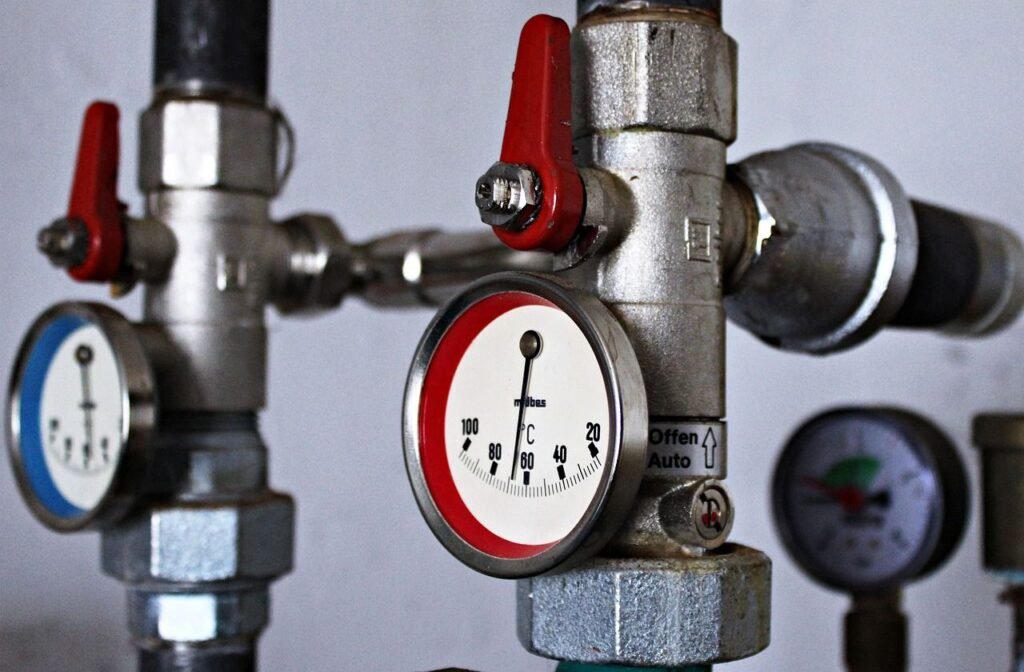
Water expands as it heats and, unlike air, barely compresses. In an open system, the extra volume pushes back through the meter into the public main and nobody notices. When a device on the supply blocks that path, the expanded water has nowhere to go, so pressure climbs every time the burner or elements run, until someone opens a faucet or the temperature and pressure (T&P) relief valve opens.
Those repeated spikes can strain the tank, the T&P valve, connectors, faucet cartridges and toilet fill valves. A relief valve that drips after the heater runs is often the first sign.
How an expansion tank works
An expansion tank is a small steel tank on the cold water line near the water heater. Inside, a diaphragm or bladder separates the water from a sealed cushion of air.
Amtrol’s installation instructions for its Therm-X-Trol tanks describe the cycle. The air pre-charge keeps water out until system pressure rises above it. As the water heats, expanded water moves into the tank and the air chamber absorbs the pressure increase, keeping system pressure below the relief valve setting. When you use hot water, the air pushes that water back into the pipes.
Two details in those instructions matter at installation:
- Pre-charge matched to your house. Amtrol tells installers to adjust the pre-charge to match the cold water supply pressure, with the tank empty of water, and warns that skipping this can damage the bladder or diaphragm.
- Location. The tank goes on the supply line between the water heater and the backflow preventer, check valve or pressure-reducing valve, mounted vertically for the models those instructions cover.
Amtrol also warns against re-pressurizing a tank after the initial installation, especially one that is corroded or damaged, and says a licensed professional should check the system, tank included, every year.

When the code requires an expansion tank
The 2024 IRC requires a way to control thermal expansion in two cases: on the house side of a pressure-reducing valve when expansion pushes pressure above the valve’s setting (P2903.4.1), and wherever a backflow preventer, check valve or similar device on a system with a storage water heater lets expansion raise the pressure (P2903.4.2).
An expansion tank is the usual answer. The code ties the requirement to those devices, not to every water heater replacement, so two neighbors with the same heater can get different answers.
Pressure is the other half. Section P2903.3.2 caps static water pressure at 80 psi and requires a pressure-reducing valve above that. Many PRVs do not let water flow backward, so adding one can bring the expansion rule into play. Colorado’s plumbing code adopts these IRC plumbing chapters as the statewide minimum, and Fort Collins, Loveland, Larimer County and Weld County enforce 2024 editions.
| On your water supply | Can expanded water flow back to the main? | What the 2024 IRC requires |
|---|---|---|
| No PRV, check valve or backflow device | Yes | No expansion control under P2903.4 |
| Pressure-reducing valve | Often not | Expansion control if pressure rises above the PRV setting (P2903.4.1) |
| Check valve or backflow preventer | No | Expansion control with a storage water heater (P2903.4.2) |
| Static pressure over 80 psi, no PRV | Yes, but pressure is too high | A PRV (P2903.3.2), which can then trigger P2903.4.1 |
How to tell if your home has a closed system
Check the main water line where it enters the house, and ask your water provider about the meter. A PRV, check valve or backflow preventer on the main supply makes the system closed.
- Find the main shutoff. It is usually where the water line comes through the basement or crawlspace wall or floor.
- Look just past it. A PRV is typically a bell-shaped brass valve with an adjusting screw on top. A check valve or backflow assembly may sit on the same line.
- Ask your water provider. A check valve can be built into the meter setup where you cannot see it, so ask your city utility or water district what is installed at your address.
- Test your pressure. A pressure gauge on an outdoor faucet or the laundry faucet reads static pressure with nothing running, and over 80 psi the code calls for a PRV. A gauge with a maximum-reading needle left on overnight can show whether pressure climbs while the heater runs and no water is used, a common sign of a closed system.

Signs an expansion tank has failed or is waterlogged
A failed tank stops absorbing expansion, so the symptoms look like having no tank at all: a T&P valve that drips or spurts after the heater runs, and pressure that climbs overnight and surges when a faucet opens.
- Dripping T&P valve, or water in the drain pan after a heating cycle. Never cap or plug the valve. Our water heater leaking guide shows how to tell a relief valve drip from a tank leak.
- Pressure swings, such as a surge when a faucet first opens or toilet fill valves that hiss after the heater runs.
- Water at the air valve. Briefly press the core of the tire-style air valve on the tank: air is normal, while water usually means the diaphragm or bladder has failed.
- A solid sound when tapped. A working tank usually sounds hollow at the air-valve end; a waterlogged one sounds solid all the way along.
- Rust or leaks at the tank’s connection or seams.
Relief valve water can scald, so keep hands and faces away from the discharge pipe. Because Amtrol warns against re-pressurizing an installed tank, a waterlogged tank is usually replaced rather than pumped back up.
Colorado’s rule: the tank cannot hang from its pipes
Colorado’s plumbing code and Larimer County’s building code amendments both say thermal expansion tanks must be supported according to the manufacturer’s instructions and “shall not be supported by the piping that connects to such tanks.”
A tank full of water is heavy, and one hanging from a threaded fitting puts constant strain on that joint and the pipe. A compliant installation typically uses a wall bracket, strap or stand that carries the tank’s weight. If your current tank hangs from its pipes, plan on proper support when it is replaced.
Replacing an expansion tank or adding one for the first time
Replacing a failed tank. The new tank is sized for your water heater and supply pressure, its pre-charge is set to match that pressure before it goes in, and it gets its own support. When we replace a water heater, we check the existing expansion tank and tell you whether it should stay.
Adding one for the first time. A home that never had a tank may need one after a PRV is added for high pressure, after a check valve or backflow device goes in on the supply, or when an existing device turns up during a water heater replacement. If the code requires expansion control, the tank goes on the quote and is inspected with the rest of the installation. Every water heater replacement here needs a permit; see do I need a permit to replace a water heater.
Cost. National cost guides give a starting point, not a Fort Collins quote. Angi’s expansion tank cost guide (updated May 29, 2025) puts the average at $325, with most homeowners paying $150-$450, and Angi’s water heater repair cost guide (updated December 17, 2025) puts replacing an existing expansion tank at $100-$400. Size, support and any PRV or piping work move the price; our water heater replacement cost guide covers the rest of an installation.
For every other code item on a new heater, see our page on water heater installation in Fort Collins. If the heater itself is failing, start with water heater replacement in Fort Collins.
Expansion tank FAQ
Do I need an expansion tank for my water heater?
Only if your plumbing is a closed system. The 2024 IRC requires thermal expansion control where a pressure-reducing valve, check valve or backflow preventer keeps heated water from flowing back to the main.
What should an expansion tank be pre-charged to?
Your home’s cold water supply pressure. Amtrol’s instructions say to set the pre-charge to match it, with the tank empty of water, before the tank is installed.
How do I know if my expansion tank is bad?
Water from the air valve, a tank that sounds solid when tapped, or a T&P valve that drips after the heater runs all point to a failed or waterlogged tank.
Does a tankless water heater need an expansion tank?
The backflow-device rule (P2903.4.2) is written for systems with storage water heaters, so a tankless heater alone does not trigger that section. A PRV, a storage tank elsewhere in the system or the manufacturer’s instructions can change the answer, so we check each installation.
Can an expansion tank hang from the water pipes?
No. Colorado’s plumbing code and Larimer County’s amendments require it to be supported as the manufacturer specifies, not by the connecting piping.
What is the maximum water pressure allowed in a house?
The 2024 IRC caps static water pressure at 80 psi. Above that, a pressure-reducing valve is required, and the PRV can then make expansion control necessary.
Keep reading
Related guides

How to Flush a Water Heater Safely: Gas and Electric Steps for Fort Collins Homes
How to flush or drain a gas or electric water heater safely, how often to do it on Fort Collins’ soft water, and when to call.
Read guide
Are Heat Pump Water Heaters Worth It? Pros, Cons and Payback in Fort Collins
Are heat pump water heaters worth it? Honest pros and cons, a payback example with 2026 rebates and Colorado winter tips.
Read guide
Colorado's Low-NOx Water Heater Law: What Changes When You Replace a Gas Water Heater in 2026
What Colorado’s low NOx water heater law means for a 2026 gas replacement: limits, propane, altitude and exemptions. Call (970) 305-5633 for a quote.
Read guidePhoto credits (Wikimedia Commons): Colorado's Low-NOx Water Heater Law: What Changes When You Replace a Gas Water Heater in 2026: Jason Woodhead, CC BY 2.0.
Water heater trouble?
Call for a diagnosis and a written quote.
Call if your relief valve drips or you need a water heater installed to code.

Water heater replacement, repair and tankless installation for Fort Collins, Loveland and Larimer County. Written, itemized quotes and licensed plumbers.
Call (970) 305-5633